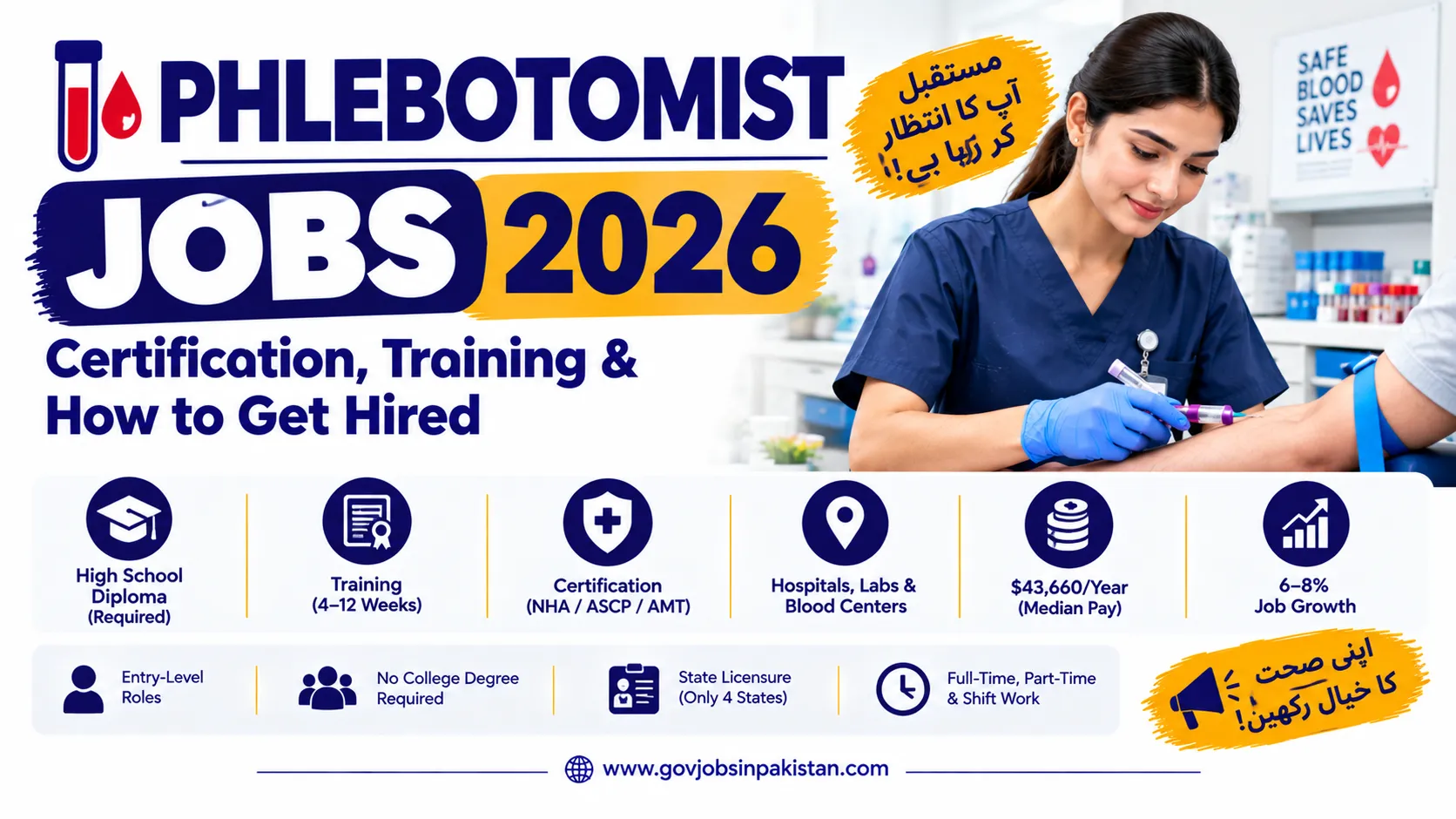

Phlebotomist jobs are one of the fastest and most accessible entry points into healthcare, requiring a short training program rather than a college degree, with strong and growing demand across hospitals, diagnostic labs, and blood donation centers. This matters to job seekers because, unlike many healthcare careers, you can typically go from starting training to holding a paid position in under a year — but knowing the right certification path (and your state’s specific rules, if applicable) makes the difference between a smooth entry and wasted time or money.
Quick Facts
| Detail | Information |
|---|---|
| What phlebotomists do | Draw blood and collect specimen samples for laboratory testing, transfusions, research, and donations |
| Minimum education | High school diploma or GED — no college degree required |
| Typical training length | 4–12 weeks for a certificate program (some accelerated options shorter; associate degree paths exist but aren’t required) |
| Typical training cost | Roughly $500–$3,000 for a certificate program; some hospital-based programs pay a stipend while you train |
| Minimum age | Typically 18, though some programs accept 17-year-olds with parental consent |
| National certification (US) | NHA (Certified Phlebotomy Technician, CPT), ASCP, or AMT — all nationally recognized; employers generally require one of these, not all three |
| State licensure (US) | Only 4 states mandate a specific state license/credential: California, Washington, Nevada, and Louisiana — most other states leave credentialing to employers and national certifying bodies |
| Typical employers | Hospitals, reference/diagnostic labs (e.g., Quest, LabCorp), blood donation centers (e.g., Red Cross), outpatient clinics |
| National median pay (US, most recent BLS data) | $43,660/year (about $20.99/hour) as of May 2024; higher in top-paying states (roughly $49,000–$50,000 in California and Washington) |
| Job outlook (US) | Bureau of Labor Statistics projects 6–8% growth, faster than the average for all occupations |
Important: Requirements outside the US vary significantly by country. If you’re not in the US, check your own country’s healthcare regulatory body for the equivalent training and certification pathway before enrolling in a program.
What Does a Phlebotomist Do?
A phlebotomist (sometimes called a phlebotomy technician) draws blood and collects other specimen samples that laboratories use for diagnostic testing, transfusions, research, and blood donation programs. The role is hands-on and patient-facing, working across hospitals, diagnostic and reference labs, blood donation centers, and outpatient clinics.
Because it requires a short training timeline compared to most healthcare careers, phlebotomy is widely regarded as one of the most accessible ways to start a hands-on healthcare career — and many phlebotomists use the role as a stepping stone toward further healthcare careers such as medical laboratory technician, medical assistant, or nursing.
Requirements to Get Started
- Education: a high school diploma or GED is the minimum requirement for virtually every phlebotomy training program and entry-level lab job
- Age: most programs require candidates to be at least 18, though some accept 17-year-olds with parental consent
- Physical ability: capability to stand for extended periods, perform precise hand movements, and maintain good vision
- Soft skills: strong communication, empathy, and attention to detail matter as much as technical skill, since much of the job involves working face-to-face with patients who are often anxious about needles
- No prior healthcare experience needed — programs are designed for complete beginners and teach all necessary skills from the ground up
If you’re changing careers from an unrelated field, you can generally move straight into a phlebotomy training program — many successful phlebotomists come from backgrounds in customer service or other fields entirely unrelated to healthcare.
Training and Certification Path
- Complete a phlebotomy training program — offered at community colleges, vocational/trade schools, and some hospital systems, typically lasting 4–12 weeks. Programs cover venipuncture technique, order-of-draw, specimen handling, OSHA safety, and patient communication. Look for programs approved by NAACLS or NHA to ensure your training is accepted for certification.
- Complete supervised clinical hours — hands-on practice is where you develop the actual skill. As one example, the NHA’s Certified Phlebotomy Technician (CPT) pathway requires evidence of successfully performing a minimum of 30 venipunctures and 10 capillary/finger sticks on live individuals, completed within the last 5 years.
- Sit for a national certification exam — the three main nationally recognized options in the US are NHA (CPT), ASCP, and AMT. All three are widely accepted; your choice mostly comes down to what’s most recognized by employers in the area where you plan to work.
- Check your state’s specific requirements (US only):
- California requires its own CPT I state certificate: 40 hours of classroom time, 40 hours of clinical practice, and a documented number of successful draws, renewed annually with a fee and continuing education.
- Washington credentials phlebotomists through the Department of Health as Medical Assistant-Phlebotomists (MA-P) — a registration step after training, not a separate degree.
- Nevada treats phlebotomists as lab assistants working under a laboratory’s own license.
- Louisiana requires a clinical laboratory personnel license from the State Board of Medical Examiners.
- All other US states rely on national certification plus employer requirements, without a separate state license.
Important: In states that don’t require licensure, it’s technically legal to work without national certification — but most employers require it as a condition of hire in practice, so completing certification is strongly recommended regardless of your state’s legal minimum.
Salary Expectations
The most recent US Bureau of Labor Statistics data (May 2024) put the national median phlebotomist salary at $43,660/year (about $20.99/hour). Pay varies by experience, certification, shift, and location — top-paying states like California and Washington average closer to $49,000–$50,000, and night-shift hospital roles typically pay more than standard day shifts. Exact pay varies by employer and region — treat these as reference figures rather than a guarantee for any specific job.

How to Find and Apply for Jobs
- Finish your training and certification first — many students receive job offers before even completing their clinical rotations, since demand is strong.
- Target the right kind of employer for your priorities:
- Hospital labs tend to pay the most but are more competitive — consider applying to several simultaneously (5–10 applications is a reasonable range).
- Reference/diagnostic labs (e.g., Quest, LabCorp) hire heavily and typically train you on their specific systems.
- Blood donation centers (e.g., Red Cross) often offer flexible schedules and are known for hiring new graduates.
- Use general job platforms like LinkedIn and Indeed, alongside your training program’s own job placement network if it offers one.
- Prepare a resume that highlights your certification, clinical hours completed, and any patient-facing or customer service experience, since soft skills are highly valued in this role.
Common Mistakes to Avoid
- Assuming a degree is required — it isn’t; a certificate program (4–12 weeks) is the standard path, not a two-year or four-year degree.
- Skipping national certification because your state doesn’t legally require it — most employers require it anyway, regardless of the legal minimum in your state.
- Choosing a training program not approved by NAACLS or NHA, which can create problems when you try to sit for certification.
- Overlooking your specific state’s additional requirements if you’re in California, Washington, Nevada, or Louisiana — these four states have their own extra licensing steps beyond national certification.
- Letting your clinical hours/draws go undocumented — certification bodies like NHA require documented evidence of a minimum number of successful venipunctures and finger sticks.
- Applying only to one type of employer — spreading applications across hospitals, reference labs, and blood centers improves your chances, since each has different hiring volume and competitiveness.
FAQs
1. Do I need a college degree to become a phlebotomist? No — a high school diploma or GED plus a short certificate program (typically 4–12 weeks) is the standard path; a college degree is not required for entry-level positions.
2. How long does it take to become a phlebotomist? Most people complete training and become certification-ready in 4–8 weeks, with some completing the full process — training plus certification — in under a year.

3. How much does phlebotomy training cost? Community college and vocational programs typically cost $500–$3,000; some hospital-based programs pay a stipend while you train.
4. What certification do I need to become a phlebotomist? In the US, the three main nationally recognized options are NHA (CPT), ASCP, and AMT — you generally only need one, chosen based on what’s most recognized by employers in your area.

5. Do all US states require a phlebotomy license? No — only California, Washington, Nevada, and Louisiana mandate specific state-level credentialing; most other states rely on national certification and employer requirements.
6. How much do phlebotomists earn? The US national median was $43,660/year (about $20.99/hour) as of May 2024, with top-paying states like California and Washington averaging closer to $49,000–$50,000.
7. What’s the job outlook for phlebotomists? The US Bureau of Labor Statistics projects 6–8% job growth, faster than the average for all occupations, reflecting strong and growing demand.
8. What employers hire phlebotomists? Hospitals, reference/diagnostic labs (such as Quest and LabCorp), blood donation centers (such as the Red Cross), and outpatient clinics.
9. Can I become a phlebotomist with no healthcare background? Yes — phlebotomy programs are designed for complete beginners, and many successful phlebotomists come from entirely unrelated fields like customer service.
10. How many venipunctures do I need to complete for certification? As one example, the NHA’s Certified Phlebotomy Technician (CPT) pathway requires documented evidence of at least 30 venipunctures and 10 capillary/finger sticks performed on live individuals.
11. Is phlebotomy a good stepping stone to other healthcare careers? Yes — many phlebotomists use the role to build clinical experience before moving into careers like medical laboratory technician, medical assistant, or nursing.
12. Where should I search for phlebotomist job openings? General platforms like LinkedIn and Indeed, your training program’s job placement network, and directly through hospital and lab career pages.

Final Words
Phlebotomist jobs offer one of the fastest, most accessible routes into a stable, growing healthcare career, requiring only a short certificate program rather than a college degree. The path is consistent: complete an accredited training program, log your required clinical hours, earn a nationally recognized certification (and, in four specific US states, an additional state credential), and then apply broadly across hospitals, reference labs, and blood donation centers. Since hiring happens continuously across thousands of individual employers rather than through one recruitment cycle, the best strategy is to get certified and start applying as soon as you’re ready.

Iqra Rasheed
 Verified Author
is a Jobs & Career Content Specialist at freejobspk.com, providing clear and source-based information about government jobs, recruitment updates, eligibility, deadlines, and application procedures in Pakistan.