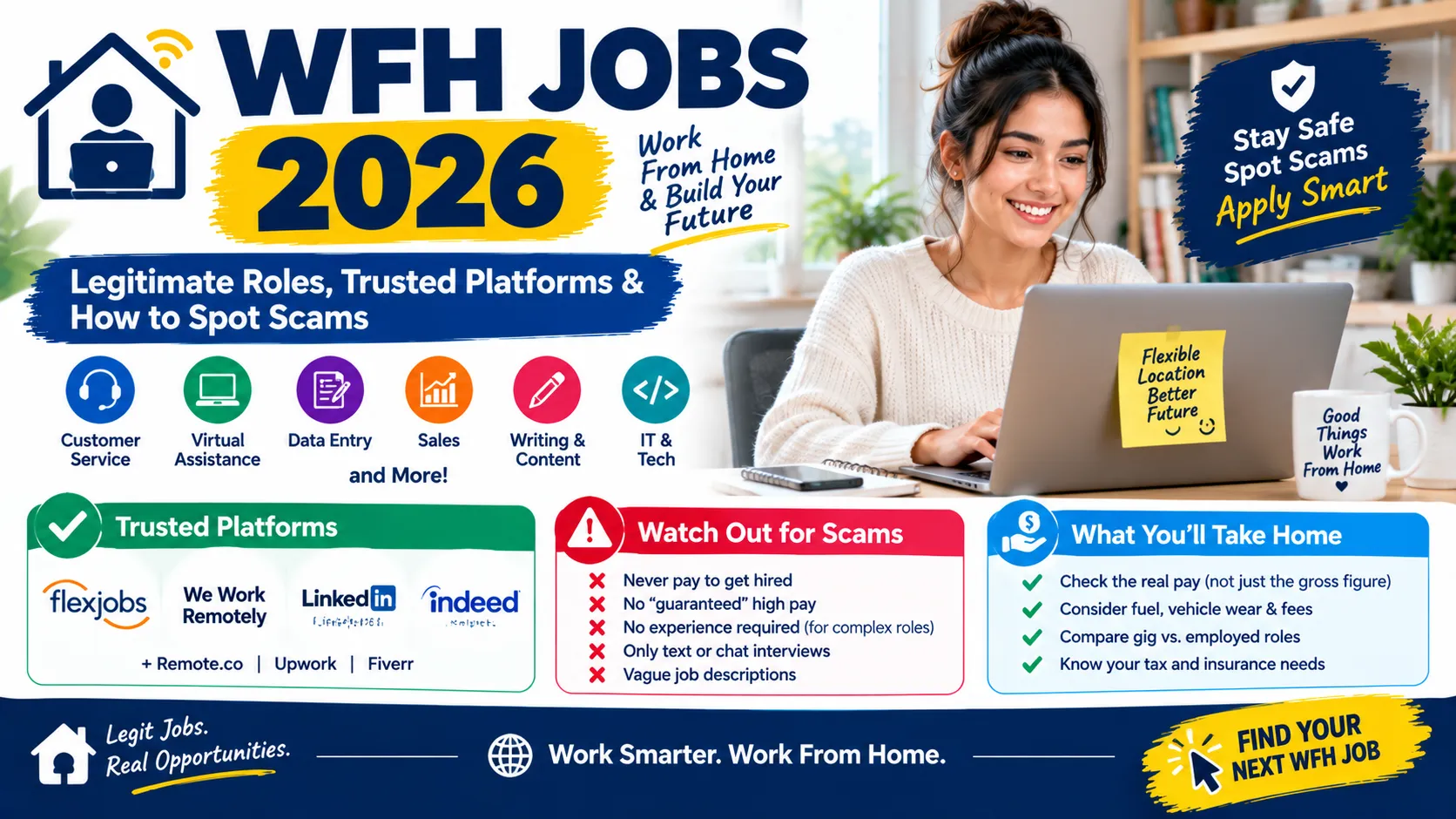

WFH jobs (work-from-home jobs) are more available now than at any point in history, spanning customer service, virtual assistance, data entry, sales, writing, and IT roles. This matters enormously to job seekers because the same search terms that surface genuine opportunities also attract a large volume of scam listings specifically designed to exploit people looking for flexible income — so before anything else, this guide focuses on how to tell the two apart.
The One Rule That Matters Most
Legitimate employers pay you. You never pay them.
If a company asks you to pay — for training materials, equipment, a “background check fee,” software licenses, or vague “startup costs” — before you’ve been properly hired, this is a scam. Full stop. The US Federal Trade Commission (FTC) has repeatedly and specifically warned job seekers about this exact pattern with bogus work-from-home offers.
Quick Facts
| Detail | Information |
|---|---|
| What “WFH jobs” covers | Remote roles across customer service, virtual assistance, data entry, sales, writing/content, IT, marketing, and administrative support |
| Scam risk level | Very high — WFH-related search terms are specifically and heavily targeted by fraudulent listings |
| Golden rule | Legitimate employers never ask you to pay money to get hired |
| Trusted, vetted job boards | FlexJobs (manually verified, paid — roughly $15/month or $50/year), We Work Remotely (manually vetted, free to browse) |
| General platforms (mixed quality, free) | LinkedIn, Indeed, Remote.co, Upwork, Fiverr — legitimate listings exist here, but verification is on you |
| Interview process (legitimate) | Involves a real, multi-step process — typically including a live video call with an actual person, not just text/chat messaging |
| Red flag categories | Envelope-stuffing/data-entry-with-guaranteed-pay offers, “no experience required” for roles that logically require skill, unrealistic pay for minimal effort, hiring after a single text conversation |
Important: Because this guide is general, always verify any specific company, platform, or listing independently before committing time or money — don’t rely on a company’s name alone as proof of legitimacy.

How to Tell a Legitimate Listing From a Scam
Signs of a legitimate opportunity:
- Lists a specific salary range (or clearly states it will be discussed, consistent with local pay transparency laws)
- Has a detailed job description — named responsibilities, required tools/software, and a clear reporting relationship
- Involves a genuine multi-step interview process, typically including a live video call with a real, identifiable person
- The company has a visible digital footprint — a professional website, an active LinkedIn presence, real employee profiles, and some public presence beyond the single job listing itself
- Never asks you to pay any money at any stage of the hiring process
Signs of a scam:
- Vague, generic phrases like “make money from home” or “easy work, great pay” — if you can’t picture what an actual workday would involve, treat that as a warning sign
- “No experience required” for a role that would normally demand real qualifications
- You’re “hired” after nothing more than a text conversation or a brief chat with someone you’ve never seen on video
- Any request for payment — for training materials, equipment, a background check fee, software licenses, or vague “startup costs” — before you’ve started genuine paid work
- The company has no searchable history: no verifiable employees, no reviews (positive or negative), no complaints on record anywhere — this absence itself is worth treating as suspicious
- Unsolicited outreach claiming to be a recruiter from a well-known company that quickly starts asking for personal or financial information
Before any interview: search the company’s name alongside terms like “scam” or “complaint,” and check the company on Glassdoor to see what current or former employees actually say.
Common Legitimate WFH Job Categories
| Category | What It Involves |
|---|---|
| Customer Service | Assisting customers via phone, chat, or email — one of the largest remote hiring categories |
| Virtual Assistant | Managing calendars, emails, scheduling, research, travel arrangements, and administrative tasks for entrepreneurs/businesses |
| Data Entry | Updating databases, processing forms, verifying records — legitimate roles exist, but this category is also heavily used by scammers, so extra scrutiny is warranted here specifically |
| Inside Sales | Outreach and sales conducted remotely via phone, Zoom, and CRM software |
| Writing / Content | Freelance or employed content creation, copywriting, and editing roles |
| IT / Technical Support | Remote technical roles, ranging from help desk support to software development |
Important: “Data entry” in particular is one of the most frequently scam-exploited categories — legitimate data entry roles exist, but this specific search term attracts an unusually high volume of fraudulent listings promising easy money for minimal effort.

Trusted Job Boards and Platforms
- FlexJobs — manually verifies every listing to confirm it’s genuinely remote and currently open; this vetting comes with a subscription cost (roughly $15/month or $50/year), which some job seekers find worthwhile specifically to avoid scam listings on free boards
- We Work Remotely — manually vets listings for legitimacy, free to use
- LinkedIn — supports quick applications and remote filters, though results can mix fully remote and hybrid roles; verifying a hiring manager or team member’s profile adds a useful confidence check
- Indeed — broad reach, but does not manually verify every listing, so apply the scam-detection checklist above to anything found here
- Remote.co, Upwork, Fiverr — useful for freelance/contract-style remote work, with their own platform-specific verification and payment protection systems
Important: Rather than creating accounts on dozens of sites, most guides recommend focusing on a small number of trusted sources you check consistently — this saves time and reduces exposure to scam-heavy, unvetted listings.
How to Search and Apply Effectively
- Start with vetted platforms (FlexJobs, We Work Remotely) if you want to minimize scam exposure, especially if you’re new to remote job searching.
- Read postings critically, not just skimmed — vague language is itself a signal, not just bad writing.
- Check the job’s actual location eligibility — many remote roles are still restricted to candidates in a specific country or region, so don’t assume “remote” means “open to anyone anywhere.”
- Research the company before any interview — search the name with “scam” or “complaint,” and check Glassdoor for real employee feedback.
- Insist on a real, verifiable hiring process — a live video interview with an identifiable person is a reasonable minimum expectation for any legitimate remote role.
- Never pay anything — no training fees, no equipment purchases, no “processing” charges — at any point before you are properly, verifiably employed and being paid yourself.
Common Mistakes to Avoid
- Paying any fee to “secure” a work-from-home job — this is the single most reliable scam indicator across every source on this topic.
- Accepting a job after only a text-based conversation — a legitimate hiring process involves real people, typically via video call.
- Chasing “no experience required” listings for roles that would normally require genuine skill — this phrasing is a common scam lure.
- Ignoring location eligibility — applying to roles restricted to a different country wastes time for both you and the employer.
- Relying solely on free, unvetted job boards without applying your own scam-detection checklist to every listing.
- Skipping the company background check — a few minutes searching a company’s name plus “scam” or “complaint” before an interview can save significant time and risk.
FAQs
1. Are legitimate work-from-home jobs actually available in 2026? Yes — remote work opportunities are more widespread than ever, spanning customer service, virtual assistance, sales, writing, and IT, though the same popularity has attracted a significant volume of scam listings using identical search terms.
2. What is the single biggest red flag for a WFH job scam? Being asked to pay money at any point in the hiring process — for training, equipment, background checks, or software — before you’ve started genuinely paid work.
3. Is FlexJobs worth paying for? Many guides recommend it specifically because it manually verifies every listing, which some job seekers find worth the subscription cost to avoid wading through scam listings on free boards.
4. Can I trust “remote” job listings on Indeed and LinkedIn? Legitimate listings exist on both, but neither manually verifies every posting the way FlexJobs or We Work Remotely does — apply your own scam-detection checklist to anything found there.
5. What if I’m offered a job after just a text message conversation? Treat this as a major warning sign — legitimate hiring processes involve real people and typically a live video interview, not just chat-based “hiring.”

6. Is data entry a legitimate WFH job category? Real data entry roles exist, but this specific term is also one of the most heavily scam-exploited categories in remote job searching — apply extra scrutiny here specifically.
7. How can I check if a company is legitimate before an interview? Search the company’s name alongside “scam” or “complaint,” and check its presence on Glassdoor for real employee reviews.

8. Do legitimate remote employers ever ask for personal information? Standard employment information (for payroll, background checks conducted by the employer, not paid by you) is normal later in a real process — but be wary of anyone asking for sensitive personal or financial details early, especially via unsolicited outreach.
9. Are remote jobs open to applicants from any country? No — many “remote” roles are still restricted to candidates in a specific country or region; always check the listing’s actual eligibility rather than assuming “remote” means fully global.
10. What categories of WFH jobs are most commonly hired for? Customer service, virtual assistant roles, data entry, inside sales, writing/content, and IT/technical support are among the most common legitimate categories.
11. Should I use many job boards or just a few? Most guidance recommends focusing on a small number of trusted platforms you check consistently, rather than spreading across dozens of sites.
12. What does the FTC say about work-from-home job scams? The FTC has repeatedly warned that legitimate employers will never ask job applicants to pay money to get a job — this is treated as the clearest, most reliable rule in the entire remote job search space.
Final Words
WFH jobs are a genuine, growing part of today’s job market, but the search term itself is a magnet for fraudulent listings — so scam awareness has to come before everything else in your search. The rule that cuts through almost every scenario: legitimate employers pay you, you never pay them. Combine that with using vetted platforms like FlexJobs or We Work Remotely, checking any company’s background before an interview, and insisting on a real, verifiable hiring process, and you’ll filter out the vast majority of fraudulent listings while still finding the genuine opportunities that do exist.

Iqra Rasheed
 Verified Author
is a Jobs & Career Content Specialist at freejobspk.com, providing clear and source-based information about government jobs, recruitment updates, eligibility, deadlines, and application procedures in Pakistan.