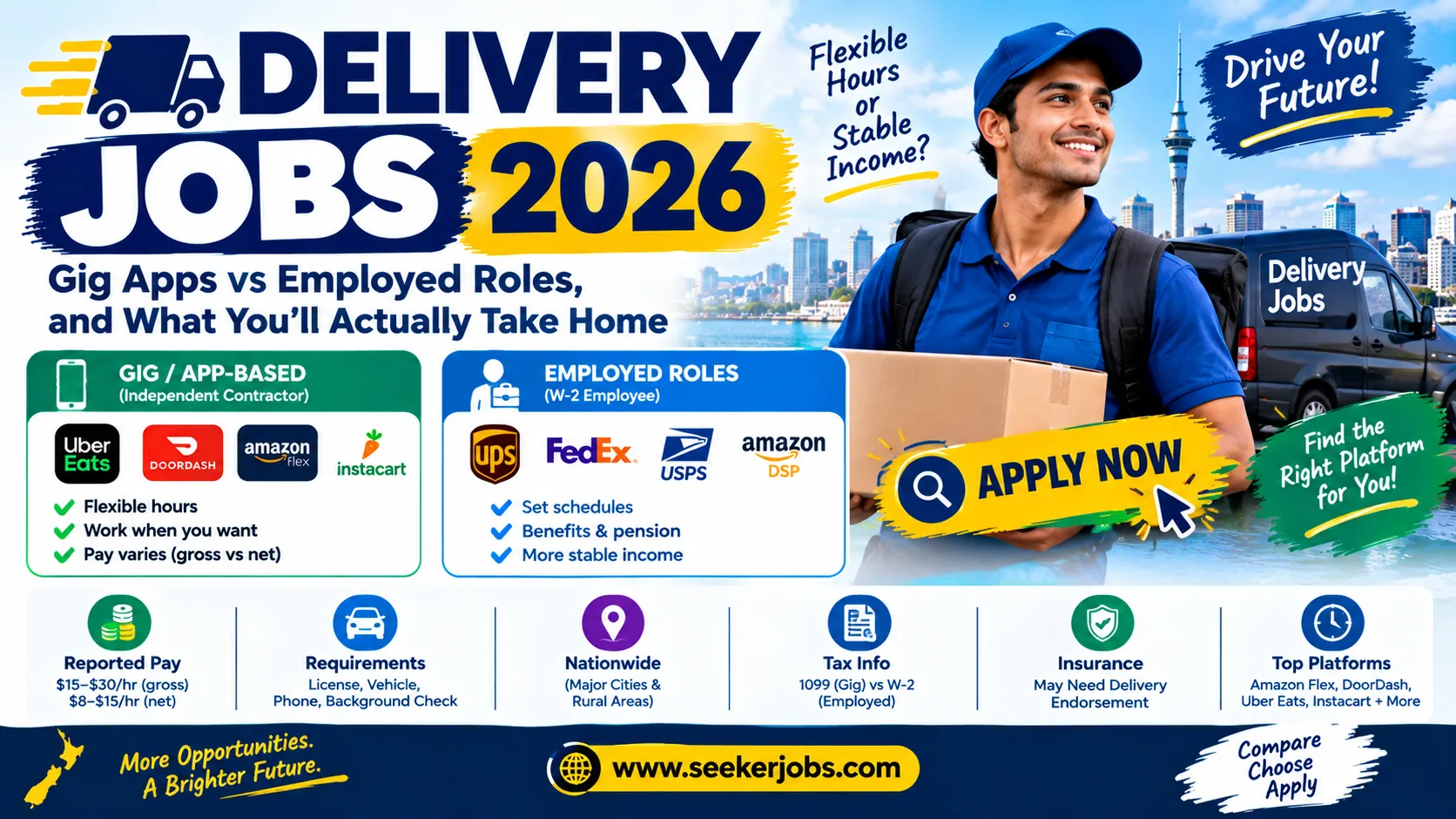

Delivery jobs span two very different worlds: flexible, app-based gig work (Amazon Flex, DoorDash, Uber Eats, Instacart) where you’re an independent contractor, and traditional employed driver roles (UPS, FedEx, USPS) with set schedules and benefits. This matters to job seekers because the two paths differ enormously in pay structure, stability, and what you actually take home after expenses — and a lot of the marketing around gig pay quotes the optimistic gross number rather than the more realistic net figure after fuel, vehicle wear, and fees.
Quick Facts
| Detail | Information |
|---|---|
| Two main paths | Gig/contractor (1099 in the US) — Amazon Flex, DoorDash, Uber Eats, Instacart, Walmart Spark; Employed (W-2 in the US) — UPS, FedEx, USPS, or an Amazon Delivery Service Partner (DSP) |
| Typical requirements | Valid driver’s license, a reliable vehicle (type varies by platform), smartphone (for gig apps), passing a background check |
| Minimum age | Typically 18+ for most gig platforms; some employed roles (e.g., commercial driving) may set a higher minimum depending on vehicle class |
| Reported gig pay (gross, per hour) | Roughly $15–$30/hour across major platforms, varying significantly by platform, market, and time of day |
| Reported gig pay (net, after fuel/vehicle wear) | Commonly $8–$15/hour lower than the advertised gross figure — this gap is the single most important thing to understand before choosing a platform |
| Employed driver pay (reported) | USPS entry rates cited around $19.83–$21.38/hour plus pension; UPS/FedEx often unionized with reported long-term earning potential in the $75,000–$110,000/year range with full benefits |
| Application Method | Directly through each platform’s own app/website (gig) or each company’s careers page (employed) |
| Vehicle insurance note | Standard personal auto insurance typically does not cover commercial delivery driving — a rideshare/delivery endorsement or commercial policy may be needed depending on your platform and location |
Important: Pay figures for gig platforms vary enormously between sources, markets, and time of year. Treat every specific number in this guide as illustrative, not guaranteed — actual take-home pay depends heavily on your location, the hours you work, vehicle costs, and platform competition for that day.
Gig/App-Based Delivery: How It Works
Gig delivery platforms let you work flexibly, generally as an independent contractor rather than an employee, using your own vehicle. Common platforms include:
| Platform | Reported Pay Range (Gross, USD/hr) | Notes |
|---|---|---|
| Amazon Flex | Roughly $18–$25 (guaranteed per scheduled “block”) | Requires a mid-size or larger vehicle for standard package blocks; scheduled blocks, not fully on-demand |
| DoorDash | Roughly $15–$25 (higher at peak times) | On-demand, no scheduling required; income more tip-dependent |
| Uber Eats | Roughly $12–$20 (higher at peak times) | Similar on-demand model to DoorDash; can work on a bike in some markets |
| Instacart | Roughly $18–$30 (varies by batch selection) | Grocery shopping plus delivery; picking higher-value batches improves pay |
| Walmart Spark | Roughly $17–$32 (higher for top-tier/peak drivers) | Delivery from Walmart stores; some sources report this among the higher-paying options |
Important: These figures are drawn from a mix of platform marketing and independent driver-tracking blogs, and different sources report meaningfully different numbers for the same platform. The gap between advertised gross pay and realistic net pay (after fuel, vehicle depreciation, and platform fees) is commonly reported as $8–$15 per hour — a driver “earning $25/hour” gross might realistically take home closer to $11–$17/hour once real costs are accounted for.
Employed Delivery Driver Roles: How They Differ
Traditional employed delivery roles — most visibly UPS, FedEx, and USPS in the US, or an Amazon-contracted Delivery Service Partner (DSP) — work differently from gig apps:
- You’re a genuine employee, not an independent contractor, with taxes withheld and (often) access to benefits
- Pay is typically hourly and consistent, rather than fluctuating with demand and tips
- Union roles (common at UPS and FedEx) are frequently cited as offering strong long-term earning potential — reportedly $75,000–$110,000/year with full benefits and pension after building seniority, though this varies by role, region, and union contract
- USPS entry-level rates are commonly cited around $19.83–$21.38/hour, with a pension as a notable long-term benefit
- Amazon DSP driver roles (driving an Amazon-branded van as a W-2 employee of a contracted delivery partner) reportedly average close to $19.80/hour, per recent wage-tracking data
Important: These figures come from third-party wage-tracking and finance blogs rather than official company pay scale publications — confirm current, exact pay directly with the specific employer before making a decision based on any of these numbers.
Requirements
For most gig delivery platforms:


- Valid driver’s license and (for most platforms) a registered, insured vehicle
- A smartphone capable of running the platform’s app
- Passing the platform’s background check
- Minimum age typically 18 (varies by platform and vehicle type)
- No prior delivery experience required — this is one of the most accessible ways to start earning quickly
For employed driver roles (UPS, FedEx, USPS, DSP):
- A valid driver’s license, potentially including a commercial driver’s license (CDL) for larger vehicles
- Passing a background check and, for some roles, a physical/medical exam
- Willingness to work a set schedule, which is less flexible than gig platforms but generally more predictable
The Insurance Question
Standard personal auto insurance typically does not cover commercial delivery driving — this is a commonly overlooked risk for new gig drivers. Depending on your platform, location, and how often you drive, you may need:
- A rideshare/delivery endorsement added to your existing personal policy (often a modest monthly add-on)
- Or to rely on the limited coverage some delivery platforms provide during active deliveries only (not while you’re just logged into the app waiting for orders)
Important: Check your own state/country’s requirements and your specific insurance policy directly — coverage gaps between platform-provided insurance and personal policy exclusions are a genuine risk area for gig delivery drivers.
How to Choose the Right Path
- If you want maximum flexibility and fast onboarding: on-demand food delivery apps (DoorDash, Uber Eats) generally have the quickest, easiest sign-up process.
- If you want more predictable pay without tip dependency: Amazon Flex offers guaranteed per-block pay, though blocks can be harder to secure in busy markets (some drivers report waitlists ranging from about a week to several months).
- If you’re comparing gig platforms purely on pay: don’t rely on advertised gross figures alone — factor in fuel, vehicle wear, and platform fees to estimate realistic net pay for your specific vehicle and market.
- If you want long-term stability, benefits, and a defined career path: employed roles at UPS, FedEx, or USPS (or as an Amazon DSP driver) generally offer more predictable income and, particularly in unionized roles, stronger long-term earning potential.
- If you want to reduce idle time between orders: many experienced drivers run two or three gig apps simultaneously, switching between them to reduce gaps and increase effective hourly pay during peak periods.
Common Mistakes to Avoid
- Treating advertised gross pay as your real take-home — always factor in fuel, vehicle depreciation, and platform fees before comparing platforms.
- Driving without confirming your insurance actually covers commercial delivery — a coverage gap here can be a costly mistake if you’re in an accident while working.
- Assuming all gig platforms have the same requirements — vehicle size, minimum age, and background check standards vary by platform.
- Chasing the highest advertised hourly rate without checking market-specific reality — pay for the same platform can vary significantly by city and time of day.
- Ignoring tax obligations as an independent contractor — gig platform earnings (1099 income in the US) require you to handle your own tax withholding, unlike a traditional employed role.
- Overlooking employed roles entirely — if long-term stability and benefits matter more to you than flexibility, a traditional UPS/FedEx/USPS-style role may outperform gig income over time, even if the headline hourly gig figure looks higher.
FAQs
1. What’s the difference between gig delivery jobs and employed delivery jobs? Gig jobs (Amazon Flex, DoorDash, Uber Eats, Instacart) are typically independent contractor work with flexible hours; employed roles (UPS, FedEx, USPS) are traditional jobs with set schedules, tax withholding, and often benefits.
2. Which delivery gig pays the most? Reports vary, but platforms like Instacart, Walmart Spark, and Amazon Flex are commonly cited among the higher-paying gig options, while food delivery apps (DoorDash, Uber Eats) tend to rank lower for solo drivers unless combined during peak hours.
3. Is Amazon Flex or DoorDash better? Amazon Flex offers guaranteed, more predictable pay per block, but requires scheduling and a larger vehicle; DoorDash offers more flexibility (log on/off anytime) with income more dependent on tips and demand.
4. Do I need a special vehicle for delivery jobs? It depends on the platform — Amazon Flex’s standard package deliveries typically require a mid-size or larger vehicle, while food delivery apps like Uber Eats may allow bikes in some markets.

5. How much do delivery drivers really take home after expenses? Commonly $8–$15 per hour less than the advertised gross rate, once fuel, vehicle wear, and platform fees are factored in — always calculate net pay for your specific vehicle before committing to a platform.
6. Do I need a college degree or experience for delivery jobs? No — most gig delivery platforms and entry-level employed driver roles require no prior experience or specific education, just a valid license and passing a background check.
7. Are UPS/FedEx/USPS delivery jobs better than gig apps? They generally offer more stability, benefits, and long-term earning potential (especially in unionized roles), while gig apps offer more flexibility but less predictable, non-benefited income.
8. Does my personal car insurance cover gig delivery driving? Usually not automatically — standard personal auto policies often exclude commercial delivery use, so check your policy and consider a rideshare/delivery endorsement.
9. Can I work multiple delivery apps at once? Yes — many experienced drivers run two or three apps simultaneously to reduce idle time and increase effective hourly earnings, especially during peak meal times.

10. How do I sign up for a gig delivery platform? Directly through that platform’s own app or website — the process typically involves providing your license, vehicle details, and passing a background check.
11. What is an Amazon Delivery Service Partner (DSP)? A company contracted by Amazon that employs W-2 delivery drivers using Amazon-branded vans — a more traditional employed alternative to the independent-contractor Amazon Flex model.
12. Is gig delivery driving considered self-employment for tax purposes? In the US, yes — gig platform earnings are typically reported as 1099 income, meaning you’re responsible for your own tax withholding, unlike a traditional W-2 employed role.
Final Words
Delivery jobs in 2026 split broadly into flexible gig-app work and traditional employed driving roles, each with genuinely different trade-offs in pay structure, stability, and benefits. The single most important thing to understand before choosing a platform is the gap between advertised gross pay and realistic net pay after fuel, vehicle wear, and fees — a headline “$25/hour” figure often nets closer to half that once real costs are counted. Whether you prioritize flexibility (gig apps) or long-term stability (UPS, FedEx, USPS, or an Amazon DSP), confirm current pay, requirements, and insurance implications directly with the specific platform or employer before committing.

Iqra Rasheed
 Verified Author
is a Jobs & Career Content Specialist at freejobspk.com, providing clear and source-based information about government jobs, recruitment updates, eligibility, deadlines, and application procedures in Pakistan.