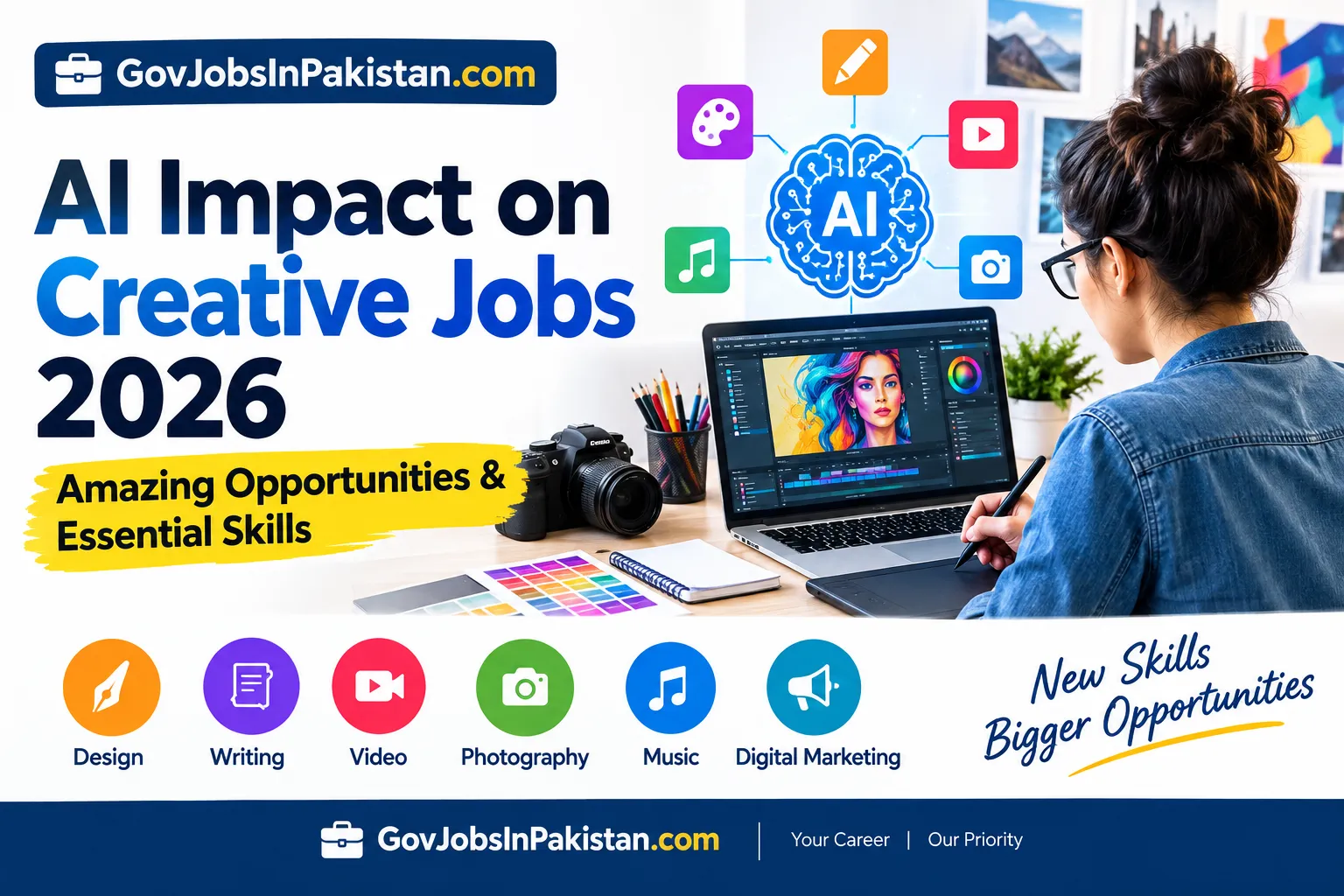

Artificial intelligence is changing how creative work is planned, produced, edited and delivered. From graphic design and writing to video production, photography, music and digital marketing, AI tools are becoming part of everyday creative workflows.
The AI impact on creative jobs is not simply about replacing people with machines. Research from the International Labour Organization (ILO) indicates that generative AI is more likely to transform many jobs and tasks than eliminate entire occupations. At the same time, creative thinking continues to be an important skill as workplaces adapt to new technology.
For creative professionals, the key issue is how work will change, which skills will become more valuable and how workers can use AI without losing the human ideas, judgment and originality that make creative work effective.
Table of Contents
- What Is the AI Impact on Creative Jobs?
- How AI Is Changing Creative Work
- AI Impact on Different Creative Careers
- Benefits of AI for Creative Professionals
- Challenges of AI in Creative Careers
- Skills Creative Workers Need in the AI Era
- Will AI Replace Creative Jobs?
- How to Prepare for AI Changes
- How Companies Are Using AI in Creative Work
- Frequently Asked Questions
- Conclusion
What Is the AI Impact on Creative Jobs?
The AI impact on creative jobs refers to the ways artificial intelligence is changing creative tasks, workflows, business models and skill requirements.
Generative AI can create or assist with text, images, audio, video and other digital content. This means some repetitive production tasks can be completed faster, while creative professionals can spend more time on concept development, strategy, editing, client communication and quality control.
The ILO’s 2025 research found that one in four workers globally are in occupations with some degree of exposure to generative AI. However, the research also emphasizes that most jobs are more likely to be transformed than fully automated because human input remains necessary for many tasks.
How AI Is Changing Creative Work
AI is affecting creative work in several major ways.
Faster Content Creation
AI tools can help professionals generate first drafts, design variations, story ideas, captions, scripts and other creative starting points. This can reduce the time required for routine production work.
A designer, for example, may use AI to explore multiple visual concepts before refining one manually. A writer may use AI for brainstorming while keeping human control over research, tone and final editing.
More Automation of Repetitive Tasks
Tasks such as background removal, transcription, image resizing, basic editing, content tagging and other repetitive processes can increasingly be assisted by software.
This does not necessarily remove the creative role. Instead, it can shift the professional’s attention toward higher-value decisions.
New Creative Workflows
AI is also creating new workflows that did not exist in traditional creative production. Professionals may now need to understand prompting, AI-assisted editing, content verification, workflow automation and model limitations.
The ILO notes that advances in voice, image and video generation have increased the potential automation of some tasks in media- and web-related occupations.
AI Impact on Different Creative Careers
The effect of AI differs from one creative career to another. Jobs with highly repetitive digital tasks may experience faster workflow changes, while roles that depend heavily on original concepts, human relationships, physical production or complex decision-making may remain strongly dependent on people.
| Creative Job | How AI Can Affect the Role | Human Value That Remains Important |
|---|---|---|
| Graphic Designer | Generates concepts, layouts and design variations faster | Brand judgment, originality, visual direction and client understanding |
| Copywriter | Assists with drafts, headlines and content ideas | Strategy, voice, fact-checking, persuasion and editing |
| Video Editor | Speeds up transcription, clipping and basic editing | Storytelling, pacing, creative judgment and final production |
| Illustrator | Produces visual concepts and references | Artistic direction, originality, style development and client needs |
| Photographer | Helps with editing, organization and image enhancement | Composition, real-world shooting, creativity and visual storytelling |
| Animator | Assists with ideation, assets and some production tasks | Character direction, storytelling, timing and artistic decisions |
| UI/UX Designer | Supports research synthesis, wireframes and design exploration | User understanding, product thinking, usability and design systems |
| Music Producer | Assists with ideas, sound generation and experimentation | Musical taste, arrangement, emotion and artistic identity |
| Marketing Creative | Produces campaign ideas, copy and content variations | Audience insight, strategy, brand positioning and creative leadership |
Benefits of AI for Creative Professionals
AI can provide several practical benefits when used as an assistant rather than as a complete replacement for human work.
Increased Productivity
Creative professionals can complete certain tasks more quickly with AI assistance. Instead of spending hours on repetitive work, they may have more time for concept development and refinement.
More Ideas and Experimentation
AI can generate multiple concepts quickly, allowing creatives to compare directions before selecting and developing one.
This can be especially useful during brainstorming, campaign planning and early-stage design exploration.
Lower Barriers to Some Creative Tasks
AI tools can make some creative software workflows easier for beginners. People may be able to experiment with writing, image creation, video editing or audio production before developing advanced technical skills.
Support for Small Businesses and Freelancers
Small teams may use AI to handle parts of content creation that previously required separate specialists or larger production budgets. Human professionals can then focus on quality, strategy and the parts of the project where experience matters most.
Challenges of AI in Creative Careers
The AI impact on creative jobs also brings important challenges.
Competition and Pricing Pressure
When certain tasks become faster to produce, businesses may compare AI-assisted work with traditional production costs. Some freelancers and entry-level workers may therefore face greater competition, especially in highly standardized content work.
Need for Continuous Learning
Creative professionals may need to update their skills more frequently. Learning only one software program or one production method may no longer be enough.
The World Economic Forum’s Future of Jobs 2025 report identifies AI and big data among the fastest-growing skill areas while also highlighting creative thinking, resilience, flexibility and lifelong learning as important skills for the years ahead.
Copyright and Ownership Questions
AI-generated content can raise questions about ownership, authorship and the use of copyrighted material.
The U.S. Copyright Office stated in its 2025 report that AI-assisted outputs may receive copyright protection when a human author determines sufficient expressive elements, while merely providing prompts does not by itself establish human authorship.
Creative professionals should therefore understand the rules that apply to their work, clients and the tools they use.
Quality and Accuracy Problems
AI-generated material can contain factual errors, repetitive ideas, visual inconsistencies or content that does not match a brand’s requirements.
Human review remains important, particularly for professional publications, advertising, journalism, branded content and client work.
Skills Creative Workers Need in the AI Era
The most useful approach is not to choose between creativity and AI. Instead, creative professionals can develop both.
Creative Thinking
Original ideas remain valuable because AI systems work from patterns and available information. Human professionals still need to decide what idea should be developed and why.
AI Literacy
Workers do not necessarily need to become AI engineers. However, understanding what AI can do, where it fails and how to use AI tools responsibly can improve productivity.
Prompting and Workflow Design
Knowing how to communicate clearly with AI tools can help professionals create better first drafts, concepts and variations.
Editing and Quality Control
The ability to identify weak output, correct errors and improve AI-generated material is becoming increasingly useful.
Communication and Collaboration
Creative work often depends on understanding clients, audiences and teams. Communication, presentation and collaboration remain important even when AI is part of the workflow.
Brand and Strategic Thinking
Businesses need more than content. They need content that supports a goal, reaches the right audience and fits a recognizable brand.
The World Economic Forum expects creative thinking and human-centered skills to remain important alongside rapidly growing technology-related skills.
Will AI Replace Creative Jobs?
The answer depends on the occupation and the tasks involved.
Some creative tasks can already be assisted or automated more easily than others. However, this does not mean that every creative job will disappear.
The ILO’s 2025 global analysis found that relatively few jobs consist entirely of tasks that can be fully automated with current generative AI. Its findings emphasize transformation and task-level change rather than universal job replacement.
In practice, a creative job may evolve rather than vanish. A designer may become more focused on creative direction. A writer may spend more time on research, editing and strategy. A video professional may use AI for routine production while concentrating on storytelling and final creative decisions.
How to Prepare for AI Changes
Creative professionals can take practical steps to remain competitive.
First, learn the AI tools relevant to your field. A graphic designer may explore image-generation and editing tools, while a writer may focus on research, drafting and editing workflows.
Second, strengthen skills that are difficult to reduce to simple automation, including creative direction, communication, strategy, storytelling and audience understanding.

Third, build a portfolio that demonstrates results rather than simply showing tool usage. Employers and clients need to see what you can create, improve and deliver.
Fourth, learn to review AI output critically. Professional-quality work still requires human judgment.
Finally, keep learning. The AI field is developing quickly, so creative professionals who regularly update their methods may be better prepared for changing workflows.
How Companies Are Using AI in Creative Work
Companies may use AI in different parts of the creative process, including:
- Brainstorming and concept development
- Marketing copy and content drafts
- Image and video ideation
- Product and campaign experimentation
- Editing and content repurposing
- Research support
- Personalization and content variation
The ILO’s research on media and culture notes that generative AI is affecting journalism, music, film production and other creative areas, including both production and aspects of creative decision-making.
At the same time, companies must consider quality, transparency, intellectual property, privacy and responsible use when introducing AI into creative workflows.
Frequently Asked Questions
Is AI reducing creative jobs?
AI is changing many creative tasks, but current research does not support the idea that all creative jobs will simply disappear. The ILO finds that job transformation is generally more likely than full replacement.
Which creative jobs are most affected by AI?
Creative jobs involving highly digital and repetitive tasks may see stronger workflow changes. However, the impact depends on the specific tasks, technology and business environment rather than the job title alone.
Is AI a threat to graphic designers?
AI can automate or accelerate parts of graphic design, such as concept generation and variations. Graphic designers can continue to add value through creative direction, branding, client communication, visual judgment and final design decisions.
Do creative professionals need to learn AI?
Learning relevant AI tools can be useful because AI is becoming part of many digital workflows. The goal is not necessarily to replace creative skills, but to combine creative expertise with technology.
Can AI-generated creative work be copyrighted?
Copyright treatment depends on the human contribution and applicable law. The U.S. Copyright Office stated in 2025 that sufficient human-authored expression can support copyright protection, while prompts alone do not establish authorship.
What skills will remain important?
Creative thinking, communication, problem-solving, adaptability, strategic thinking and quality control are likely to remain valuable alongside AI and technology skills. The World Economic Forum specifically identifies creative thinking and adaptability among skills expected to rise in importance.
Conclusion
The AI impact on creative jobs is already changing how creative professionals work. AI can speed up repetitive tasks, generate ideas and support production, but human creativity, judgment, strategy and communication remain important.
The most practical response is to learn how AI fits into your profession while strengthening the human skills that add unique value. Creative workers who understand both their craft and modern AI workflows can adapt their careers as technology continues to evolve.
AI should therefore be viewed not only as a source of disruption, but also as a tool that can change creative work, create new workflows and open new opportunities for professionals who are ready to learn and adapt.
Rank Math SEO Form Settings
Focus Keyword:
AI Impact on Creative Jobs
SEO Title:
AI Impact on Creative Jobs 2026 – Amazing Opportunities & Essential Skills
URL Slug:
ai-impact-on-creative-jobs
Meta Description:
Explore the AI impact on creative jobs in 2026, including career changes, essential skills, opportunities, challenges and how creative professionals can adapt.
Schema Type:
Article
Featured Image Filename:
ai-impact-on-creative-jobs-2026.jpg
Image Alt Text:
AI Impact on Creative Jobs 2026
Image Title:
AI Impact on Creative Jobs 2026
Secondary Keywords:
AI and creative jobs
AI impact on jobs
AI creative careers
AI in creative industries
future of creative jobs
AI and graphic design jobs
AI and writing jobs
creative jobs in 2026
AI automation and creativity
AI skills for creative professionals
How to Apply for Creative Jobs in the AI Era
Finding creative jobs in the AI era starts with identifying roles that match your skills and experience. You can search for positions such as Graphic Designer, Content Writer, Video Editor, UX Designer, Digital Marketing Specialist, Illustrator, Animator and AI Content Specialist.

Iqra Rasheed
 Verified Author
is a Jobs & Career Content Specialist at freejobspk.com, providing clear and source-based information about government jobs, recruitment updates, eligibility, deadlines, and application procedures in Pakistan.